Using AgNav to support on farm decision making
Michael O’Donnell, a calf-to-beef farmer in Clonmel, Co. Tipperary, explains how he is using AgNav, supported by his Teagasc Signpost Climate Adviser, Leonard Betts. “I’m farming 130 acres near Clonmel – a mix of owned and rented land. I’m calf to-beef the last four years. Before that, it was store-to-beef. I buy-in calves both in autumn and in spring to spread the workload. My focus is really just on producing them as efficiently as I can. “I was introduced to AgNav by my Teagasc climate adviser last year and I’m using it to try to improve efficiencies on the farm. I logged in with my ICBF login, which is handy, and all the information from my previous Bord Bia audit was there”.
“It’s actually very simple to use. You can log in and play around with the Forecaster tool. For example, you can change the dates for when you let animals out to grass in spring and when they’re brought in, and you’ll see the difference that this makes to your emissions. “I would say to other farmers to try it. Play with it and see how you can reduce your emissions with small, incremental
changes on your farm”.
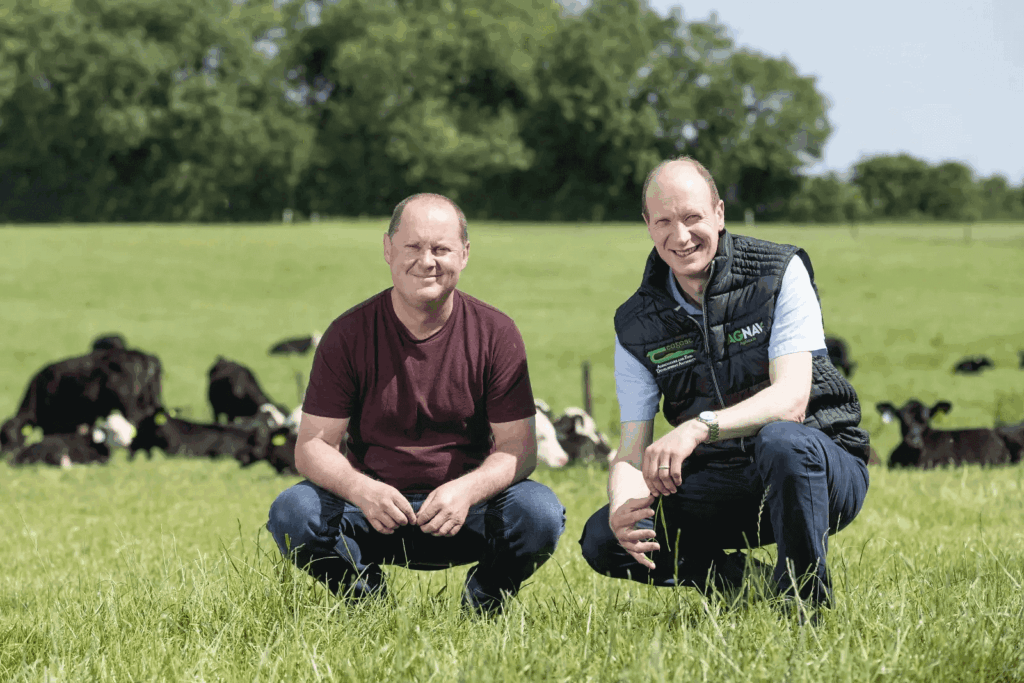
“I’ve made a few small but significant changes. All the nitrogen I’ve bought this year is protected urea – I’ve used no CAN. I targeted getting all the slurry out in springtime and after the first cut of silage. Usually I would leave some until the autumn time, but you get more use out of it in the spring. I’ve also been using LESS equipment for the last few years, which is another big improvement I’ve made to reduce emissions. “Definitely getting the animals out onto grass earlier is a big help and keeping them out longer. Those extra one or two weeks at grass can make a big difference to your emissions, and you can see that when you play with the Forecaster tool. There are big improvements to be made from simple actions on the farm.”
‘If it’s measured, it’s managed’: Why the Gleesons use AgNav
Dairy farmers Katie and Phil Gleeson explain how they have used AgNav on their farm, supported by their Teagasc Signpost Climate Adviser, Padraig Fogarty.
“We’re a spring-calving herd here – we’re running about 100 cows every spring. We graze from early February and hopefully keep them out until mid-November. It’s a family-run farm – no staff, just the three of us keeping things going [Phil, Katie, and Phil’s dad]. In farming now sustainability is the name of the game, and we wanted to incorporate sustainable actions into our farm to make it more productive and to help the environment”.
“We first heard about AgNav through Teagasc and again at our local discussion group. It’s great to have a platform that pulls together all the existing data – from Bord Bia, ICBF – and gives you a clear picture of what’s happening on your farm. If it’s measured, it’s managed and we can figure out how to reduce emissions further as we go about our everyday actions.
“We’ve already made some big changes. We’ve completely moved away from CAN and now use 100% protected urea. All of our slurry is spread using LESS equipment and we make sure to get most of it – around 75% – out in the spring, when it’s more effective. “We’re also incorporating clover into our re-seeds, so that reduced our fertiliser use. We are trying to minimise chemical fertiliser and maximise the use of organic N. “Since switching to protected urea, we’ve already seen a drop in our carbon footprint. It’s been the most noticeable impact so far.
“One thing we’re really focusing on now is herd genetics. We’re using sexed semen on our best cows to improve milk solids and yield, and we’re being very selective with the bulls we use. Through the EBI section in the AgNav Forecaster, we can actually see the improvements we’re making – not just in performance, but in our carbon footprint too. Genetics has a huge role to play, and now we can measure the difference it makes.
“We’ll keep using AgNav to guide what we’re doing. It simplifies things. It’s giving farmers an idea of where they are and what their options are. You can build a clear action plan with real targets. “For us, it’s about doing what’s right for the farm now – and what’s right for the future.”